

You plan a culinary workshop, the energy in the room is electric, the food is great, and everyone leaves smiling. So it was a success, right? Maybe. But if you are an event planner or corporate team leader, knowing how to measure success of culinary workshops goes well beyond a good vibe. Without a structured framework, you are guessing at ROI, flying blind on behavior change, and missing the story that would convince leadership to do it again. This article gives you the full recipe.
| Point | Details |
|---|---|
| Start before the workshop | Set baseline metrics for engagement, productivity, and team dynamics before the event to enable real comparisons afterward. |
| Use a four-level model | Apply Kirkpatrick’s four-level evaluation to measure reaction, learning, behavior, and business results in sequence. |
| Go beyond satisfaction scores | Satisfaction surveys reveal if participants liked the event but do not confirm whether skills transferred to the workplace. |
| Calculate real ROI | Convert measurable benefits like reduced turnover and improved productivity into financial terms and compare them to your total costs. |
| Report with context | Tailor your success story to each audience, linking culinary workshop outcomes directly to organizational goals executives care about. |
Before you can evaluate anything, you need to know what success looks like for your team. That sounds obvious, but most planners skip this step and pay for it later.
Start by anchoring your workshop to specific team-building objectives. Are you trying to improve cross-department communication? Reduce conflict? Build trust among a newly merged team? Your answer shapes every metric you will track. A workshop designed to improve collaboration needs different measurements than one focused on creative problem-solving.
Once your goals are clear, establish baselines. Pre-event baselines for engagement, productivity, and turnover make it possible to attribute improvements to the workshop rather than to coincidence. Without them, you are comparing something to nothing.
Here are the core KPIs to set before the event begins:
For data collection tools, keep it simple. A pre-event Google Form, a quick Slack poll, or a one-page paper survey all work. The point is consistency: whatever you track before the event, track the same thing after.
| Measurement type | Tool | Timing |
|---|---|---|
| Engagement | Pulse survey | 1 week before |
| Collaboration | Manager rating form | Day before |
| Productivity | Output data pull | 2 weeks before |
| Skill level | Self-assessment form | Day of event |
| Satisfaction | Post-event survey | Immediately after |
Kirkpatrick’s four-level model is the most trusted framework for evaluating training and team-building events. Here is how to apply each level specifically to culinary workshops.
Level 1: Reaction. This is your satisfaction score. Send a short survey immediately after the workshop asking about enjoyment, perceived relevance, and chef facilitation quality. Keep it to five to seven questions. This data is easy to collect but reaction data alone does not tell you whether learning happened or skills transferred. Use it as a starting point, not a finish line.
Level 2: Learning. Did participants actually gain something? For a culinary workshop, learning shows up in observable kitchen performance: knife skills, timing coordination, clear communication under pressure. Use a brief pre and post skill assessment. You can also ask participants to name two team communication techniques they practiced during the session. Comparing answers before and after gives you a concrete learning delta. For more ideas on pre and post assessments for culinary programs, there are structured approaches worth exploring.
Level 3: Behavior. This is where most event planners drop the ball. Behavior measures whether participants applied what they learned back at work. Did the team that struggled to communicate in the kitchen start running tighter meetings? Did the department that never collaborated on projects start doing so? Manager and peer observations conducted 30 to 60 days after the workshop are the most reliable way to assess this. Build a short observation checklist for managers tied to your original workshop goals.
Level 4: Results. This is the business case. Link behavior changes to the KPIs you set in your baseline. Did turnover drop? Did project output increase? Did employee engagement scores improve? Concrete operational metrics like error rate reduction, rework frequency, or retention improvements tied to a clear logic model make your results credible.
Pro Tip: Do not wait until after the event to design your Level 3 and Level 4 measurement plan. Build the manager observation form and the 60-day follow-up survey before the workshop takes place. This small act of backward design changes everything.
Kirkpatrick gives you the evaluation structure. These additional metrics fill in the financial and human picture.
Calculating ROI is simpler than it sounds. The formula is straightforward: ROI = ((Benefits – Costs) / Costs) x 100. The hard part is converting benefits into dollars. Here is how to do it:
Supplementary engagement metrics add texture to the numbers. Engagement surveys, project completion rates, and meeting efficiency are all trackable before and after a culinary workshop. Pair those numbers with qualitative feedback from manager observations, peer reviews, and participant self-assessments to get the full picture.
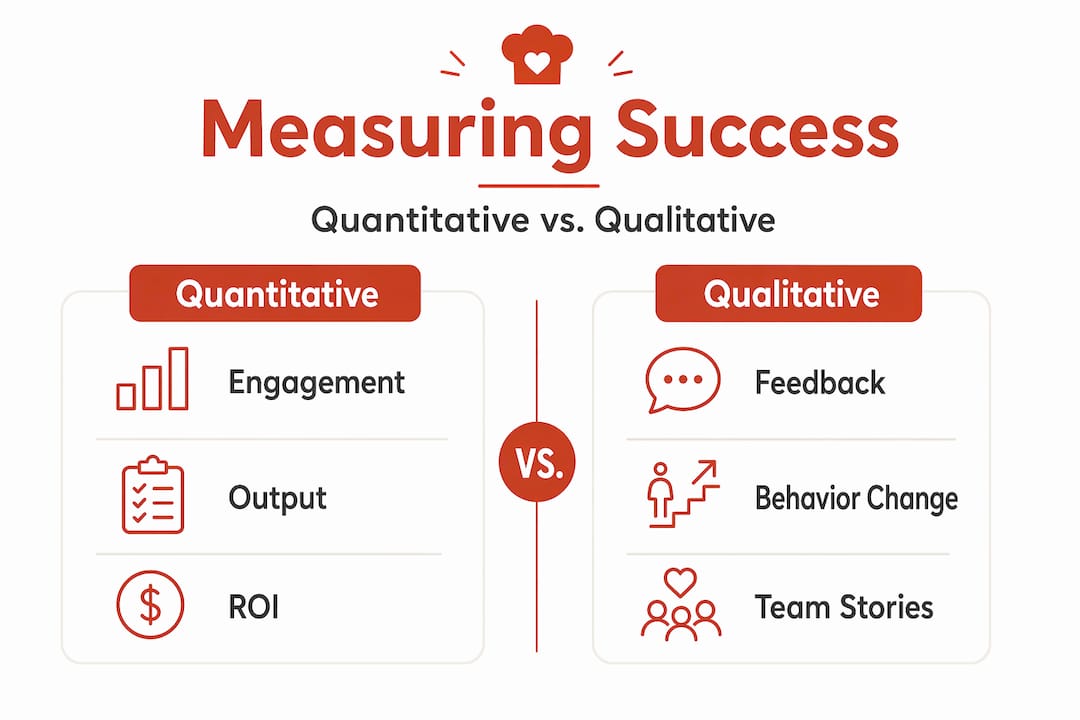
Here is a comparison of quantitative versus qualitative success indicators:
| Metric type | Examples | Strength | Limitation |
|---|---|---|---|
| Quantitative | Turnover rate, productivity, absenteeism | Credible, comparable, stakeholder-friendly | Can miss nuance and context |
| Qualitative | Manager observations, peer feedback, self-assessments | Rich context, captures soft skills | Subjective, harder to aggregate |
Combining quantitative and qualitative metrics produces a realistic and complete picture of success. One without the other leaves gaps.
Pro Tip: When collecting manager feedback, use a structured form with specific behavioral prompts rather than open-ended questions. “Has the employee demonstrated clearer communication during team meetings in the past 30 days?” gets you far more useful data than “How has the employee changed?”
Even the best measurement plans hit friction. Here is what to watch for and how to handle it.
Balancing the numbers with the narrative is the real skill in assessing cooking workshops. Data without context misleads. Context without data is anecdote. You need both.

You have the data. Now you need to tell a story that resonates. Different audiences need different framings.
For executives, lead with business outcomes. Show the ROI calculation, connect workshop goals to team KPIs, and keep the deck short. Three to five key metrics with trend visuals land better than a detailed report.
For team members, focus on growth and connection. Share anonymized highlights from peer feedback, celebrate observable behavior improvements, and reinforce the experience with photos or recap video.
For vendors or future planning, include process metrics: facilitation ratings, logistics scores, and the quality of the pre and post assessment tools. This data helps you build on team bonds established through culinary experiences and refine future events.
A well-built success summary covers four things: what you set out to achieve, what you measured, what changed, and what comes next. Keep it visual where possible. Charts showing before-and-after engagement scores or turnover trends make the story undeniable.
I have seen dozens of culinary team-building events evaluated with nothing more than a net promoter score and a stack of smiling faces in photos. Planners walk away thinking the job is done. It rarely is.
The events that actually move the needle on team performance are the ones where the measurement was designed before the menu. Start from the business result you want, then work backward to identify what behaviors would produce it, what skills would support those behaviors, and what the workshop needs to teach. That is backward design, and it changes how you structure everything from the chef briefing to the debrief conversation at the end of the night.
My honest take: success metrics for cooking classes should feel as intentional as the recipes themselves. Most teams underinvest in post-event follow-up because measurement feels like extra work. But the 60-day manager check-in, the follow-up survey, the before-and-after productivity pull: these are the ingredients that turn a fun afternoon into a credible business investment.
Measurement also becomes a continuous improvement tool when you treat it that way. The data from each event feeds into the next one. You learn which team dynamics respond best to culinary pressure, which groups need more structured debrief time, and which KPIs actually shift. That accumulated knowledge is worth more than any single satisfaction score.
The true measure of a culinary workshop is not how good the food tasted. It is how differently the team operates six weeks later.
— David
If you are ready to stop guessing and start measuring what actually matters, Recipeforsuccess is built for exactly that. Chef-led culinary team-building experiences are designed with corporate outcomes in mind, not just a great meal.
Every program through Recipeforsuccess can be paired with structured pre and post measurement tools, so you walk away with data, not just memories. Whether you are planning a single event or a series, the culinary challenge program gives your team a hands-on, high-energy experience while giving you the reporting framework to prove its value to leadership. Ready to cook up something worth measuring? Start here at Recipeforsuccess.
Measure success across four levels: participant satisfaction, skill and knowledge gains, on-the-job behavior change, and tangible business results like improved retention or productivity. Using pre-event baselines makes your comparisons credible.
Beyond satisfaction scores, the most telling indicators of successful culinary training are changes in team engagement, collaboration behavior observed by managers 30 to 60 days post-event, and measurable productivity or turnover shifts tied to your original goals.
Use the formula ROI = ((Benefits – Costs) / Costs) x 100, converting benefits like reduced turnover or increased output into dollar values and comparing them to your total workshop cost, including facilitation, venue, and materials.
Reaction surveys confirm participants enjoyed the event, but they do not confirm learning transfer or workplace behavior change. Satisfaction data should be one input in a multi-level evaluation, not the final measure of workshop effectiveness.
Collect immediate satisfaction data on the day of the event, learning assessments within one week, and behavioral observation data 30 to 60 days post-event to capture how skills have transferred into daily work habits.