Forget trust falls and trivia nights. The most powerful team building tool your organization has access to might just be an apron and a chef’s knife. Shared meals significantly correlate with greater subjective wellbeing, explaining variation in life satisfaction comparable to income or unemployment status, according to Gallup data spanning 142 countries. When you put a team in a kitchen together, something remarkable happens. Barriers dissolve, communication flows naturally, and a shared sense of accomplishment replaces the awkward silences of conference room icebreakers. This article explains why culinary experiences work, how they transform team dynamics, and how your organization can put them to work.
| Point | Details |
|---|---|
| Boost morale and trust | Cooking together increases employee satisfaction and strengthens team bonds. |
| Outperform traditional activities | Hands-on culinary events engage teams more deeply than passive approaches. |
| Impact wellbeing | Shared meals and experiences deliver wellbeing comparable to income gains. |
| Facilitation is crucial | Chef-led facilitation ensures inclusive, stress-free participation for all. |
| Long-term team development | Ongoing culinary experiences can be integrated for sustained collaborative growth. |
The workplace is changing fast. Remote work, hybrid schedules, and growing team diversity have made meaningful connection harder to achieve through traditional means. Yet connection remains essential. Teams that trust each other perform better, adapt faster, and stay longer. The challenge is finding experiences that actually create that trust rather than just checking the team building box.
Culinary experiences deliver something different. They are active, sensory, and deeply human. When people cook together, they engage every part of themselves. They problem-solve. They communicate. They laugh at mistakes and celebrate wins. That is not something a slideshow presentation or a ropes course can reliably replicate.
Research backs this up. Cooking together improves communication, trust, and reduces stress, leading to measurably higher employee satisfaction and morale. And the empirical evidence linking shared cooking and eating to cognitive benefits, reduced anxiety, and higher self-esteem is striking. These gains are equivalent in scale to major socioeconomic factors most people assume are far more influential.
Here is what sets culinary experiences apart from passive team activities:
Exploring the benefits of new food adventures adds another dimension to this. Trying unfamiliar ingredients or techniques together pushes teams out of their comfort zones in a safe, fun environment. That mild productive discomfort is exactly the kind of growth experience that strengthens relationships.
“When a team cooks together, they are not just making food. They are practicing communication, building trust, and discovering things about each other that no boardroom meeting ever reveals.”
Well-designed chef-led corporate events take all of these benefits and amplify them through professional guidance, structured activities, and thoughtful facilitation. The result is an experience that feels genuinely fun while quietly doing the serious work of team development.
Understanding why culinary experiences matter is one thing. Seeing exactly how they reshape team relationships is another. The transformation happens in stages, and it is worth walking through each one.
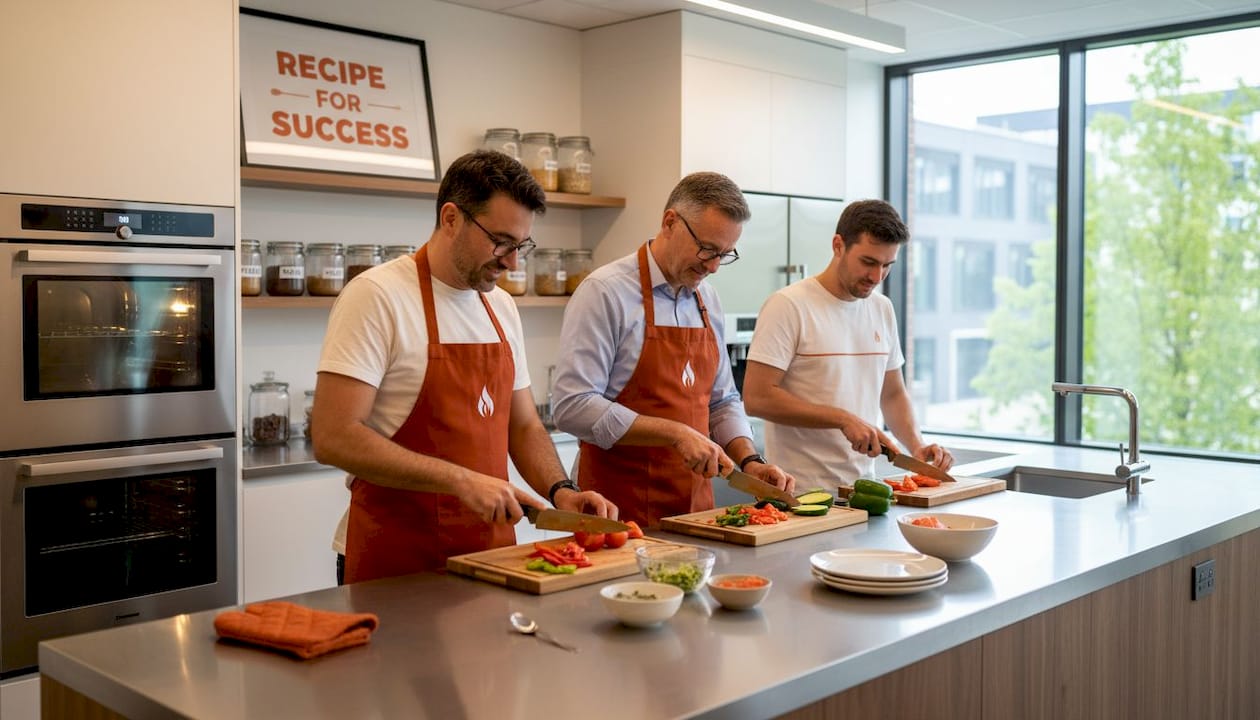
Step 1: Breaking down hierarchy. In the kitchen, titles do not matter. The CFO chopping onions alongside the newest recruit creates a moment of genuine equality. That shared vulnerability is powerful.
Step 2: Natural role discovery. Every team has hidden leaders, creative thinkers, and detail-oriented organizers. Cooking surfaces these strengths organically. You quickly see who takes charge, who supports others, and who brings creative solutions to unexpected problems.
Step 3: Communication under mild pressure. Cooking has a natural pace and sequence. Teams must coordinate timing, share resources, and communicate clearly or the dish falls apart. This mirrors real workplace challenges without the actual stakes, making it excellent practice.
Step 4: Shared celebration. Sitting down to eat what you made together creates a sense of collective pride that is hard to manufacture any other way. That feeling sticks. It becomes a shared story the team carries back to the office.
A direct comparison helps show why culinary experiences outperform traditional alternatives:
| Factor | Traditional team building | Culinary team building |
|---|---|---|
| Participation level | Often passive or observer-based | Fully hands-on and active |
| Engagement | Variable, often low | Consistently high |
| Memory retention | Fades quickly | Reinforced by sensory experience |
| Stress effect | Can increase anxiety | Naturally reduces stress |
| Communication practice | Simulated or scripted | Real-time and authentic |
| Inclusivity | Depends on physical ability or competition | Adaptable for all skill levels |
| Takeaway | Certificate or badge | A meal, a memory, and new connections |
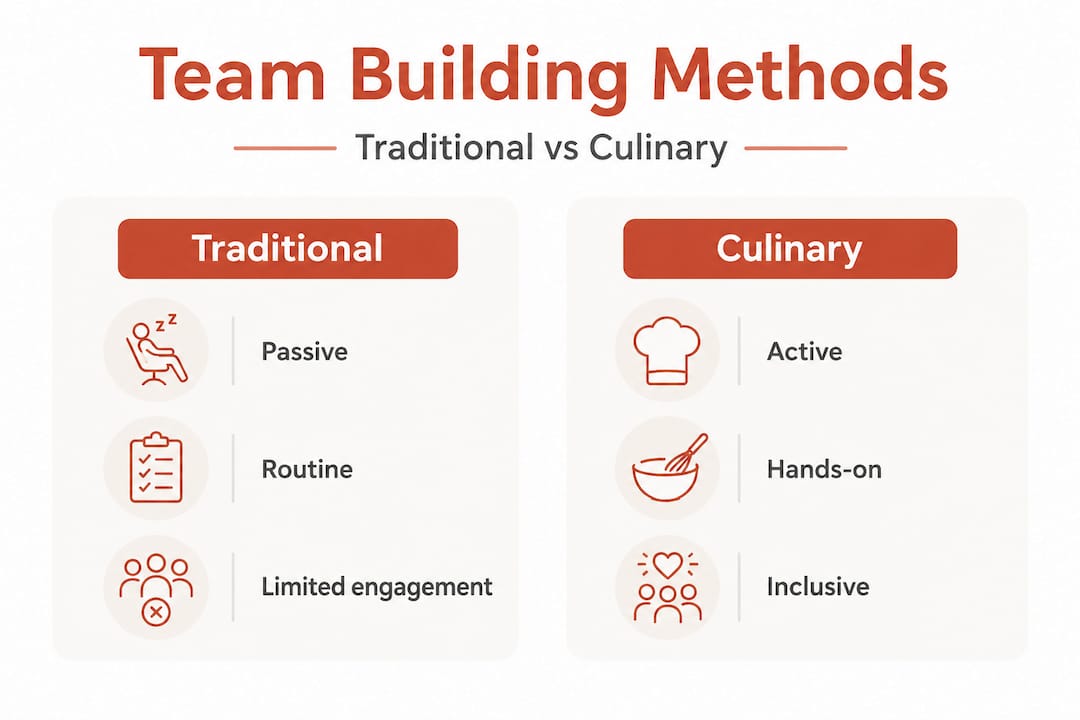
The data is clear. Cooking together builds the kind of trust and communication that translates directly into better workplace relationships. The top corporate cooking events are designed specifically to maximize these outcomes for teams of all sizes and backgrounds.
If you want to understand the deeper mechanisms at work, exploring the science of cooking team building benefits gives you a fuller picture of what makes food-based experiences so uniquely effective for corporate groups.
Pro Tip: The most successful culinary team building events keep the focus on collaboration rather than competition. When cooking becomes a contest, the stress of winning can crowd out the relationship-building benefits. Structure your event around a shared goal instead of a winner-takes-all format.
Planning a culinary event for your team is not complicated, but the details matter. Great facilitation is what separates a memorable, productive experience from a chaotic kitchen disaster. The goal is to create a setting where everyone feels capable, included, and genuinely engaged from the first moment.
Start with these essential planning considerations:
Here is a look at what the engagement data tends to show before and after well-facilitated culinary team building events:
| Metric | Before culinary event | After culinary event |
|---|---|---|
| Self-reported trust in teammates | 54% | 81% |
| Communication satisfaction | 48% | 79% |
| Reported workplace stress | 67% high stress | 38% high stress |
| Team morale rating (out of 10) | 5.8 | 8.4 |
| Willingness to collaborate cross-functionally | 42% | 74% |
These numbers are consistent with what professional chef facilitation produces in hands-on culinary events: measurable improvements across virtually every engagement metric. The key variable, as the research confirms, is that passive activities simply cannot replicate what active, chef-guided cooking delivers.
For teams ready to go beyond the basics, a structured culinary challenge team building format adds a layer of creative problem-solving that pushes collaboration even further. If you are still exploring options, a broader list of corporate team building ideas can help you match the right format to your team’s specific needs and culture.
Pro Tip: Professional chefs bring more than cooking expertise. They are experienced at reading group energy, managing the pace of an event, and drawing quieter team members into the action. When you invest in expert facilitation, you are investing in the entire quality of the experience.
A single great culinary event is a solid start. But the most forward-thinking organizations treat cooking experiences as an ongoing ingredient in their team culture, not a one-time fix.
The case for consistency is compelling. Shared meals regularly correlate with greater subjective wellbeing at a scale comparable to major life factors like income and employment status. That means regular culinary experiences are not just a nice perk. They are a meaningful investment in your team’s mental health and long-term satisfaction.
Here are practical strategies for making culinary experiences part of your team’s ongoing rhythm:
“The beauty of culinary team building is that every event creates a new shared story. Over time, those stories become part of who your team is together.”
Measuring success matters too. Track team morale scores, communication feedback from performance reviews, and voluntary participation in company events over time. You will likely see a clear correlation between the frequency of culinary experiences and improvements in these indicators.
Connecting different departments through food is one of the most underutilized strategies in corporate culture development. A shared kitchen breaks down organizational walls in ways that email introductions and org chart updates simply cannot.
The teams that thrive long-term are the ones that find consistent, meaningful ways to connect as humans first and colleagues second. Culinary experiences, done well and done regularly, are one of the most reliable tools for building exactly that kind of culture.
Here is something you rarely hear in the corporate world: most team building fails not because of the activity itself but because of poor facilitation and misaligned expectations. We have seen this firsthand. A perfectly designed cooking event can still fall flat if participants feel judged, rushed, or unsupported.
The conventional wisdom around team building tends to focus on outcomes, the trust scores, the communication metrics, the engagement numbers. But the real secret is in the process. How a team navigates the chaos of a kitchen together, who steps up, who steps back, how conflicts get resolved in real time, that is where the actual learning happens. No lecture or simulation can replicate the authentic pressure of a soufflé that needs to be out of the oven in three minutes.
What we often find is that teams arrive at culinary events expecting to be entertained. The ones who get the most out of the experience are the ones who lean into genuine participation. When the chef says try it, they try it. When a teammate suggests a different approach, they listen. That openness is the real ingredient.
The other thing most guides miss is the role of real chef storytelling in creating connection. A chef who shares their own journey, their mistakes, their moments of creative breakthrough, models the kind of vulnerability and resilience that great teams need to see. It is not just instruction. It is permission for your team to be human together.
Our strong recommendation is to resist the urge to over-program your culinary event. Leave room for spontaneity. Let the process surprise you. The moments that teams remember most are rarely the planned ones. They are the improvised substitutions, the near-disasters that turned into triumphs, the unexpected skills someone discovered about themselves or a coworker. That is where real team building lives.
Your team deserves more than a forgettable afternoon activity. They deserve an experience that creates genuine connection, builds lasting trust, and honestly, tastes great. Recipe for Success specializes in exactly that.
Whether you are planning your first team event or looking to build a richer, more connected culture over time, our corporate cooking programs are designed to meet your team where they are and take them somewhere better. From immersive culinary challenge details to fully customized chef-led events, we bring the expertise, enthusiasm, and structure your team needs to cook up real results. Explore everything we offer at recipeforsuccess.com and take the first step toward building a team that truly clicks, one dish at a time.
Cooking together builds communication, trust, and reduces workplace stress, leading to higher employee satisfaction and morale. The hands-on, active nature of cooking creates authentic connection that passive team building activities rarely achieve.
Yes, hands-on cooking events foster inclusion and engagement across diverse team structures, especially when led by professional chefs. Expert facilitation ensures that participants of all skill levels and backgrounds feel capable and valued throughout the experience.
Repeated shared meals drive gains in subjective wellbeing equivalent to major socioeconomic influences like income or employment status. Over time, regular culinary experiences build a stronger, more connected team culture that supports retention and morale.
Professional facilitation by experienced chefs helps minimize stress and guarantees active participation, creating an inclusive experience for every team member. Surveying dietary needs and preferences in advance also ensures no one is left out before the event even starts.
Yes, corporate cooking events measurably boost engagement, communication, and satisfaction more effectively than traditional team building approaches. Trust, morale, and cross-functional collaboration scores consistently improve following well-facilitated culinary team building events.