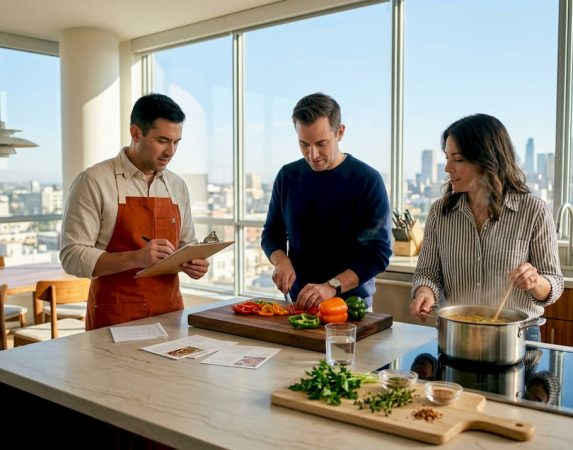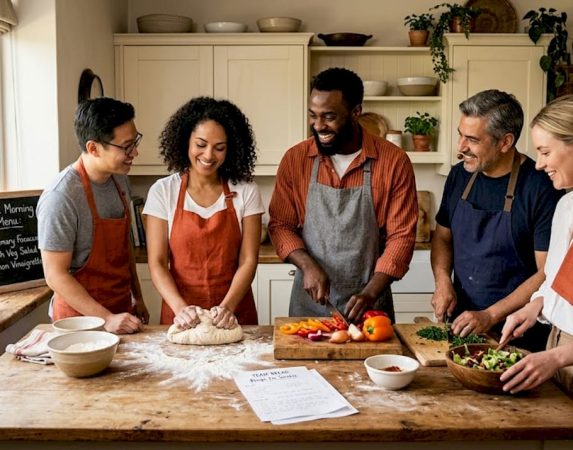
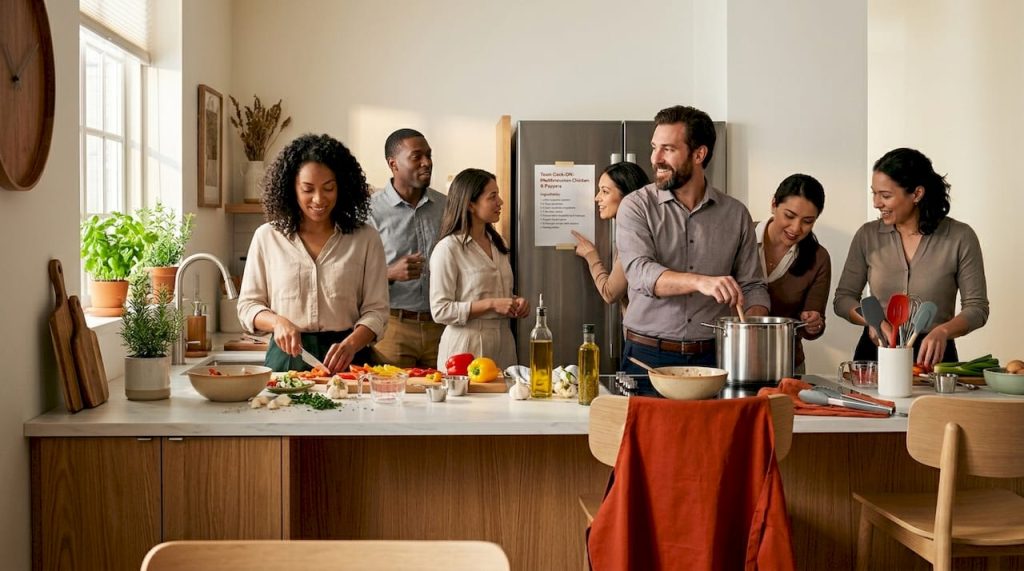
Most people hear “cooking event” and picture a fun but forgettable afternoon. Maybe some chopped vegetables, a few laughs, and a meal that nobody will talk about on Monday. But what is experiential cooking, really? It’s not a cooking class. It’s not a dinner party. It’s a structured, chef-led activity where your team works together under real pressure, solves problems in real time, and walks away with stronger relationships than any trust fall exercise could build. This guide breaks down exactly how it works and why HR managers and team leaders are making it their go-to team-building tool.
| Point | Details |
|---|---|
| Experiential cooking defined | It’s an interactive team-building method where employees cook together to enhance collaboration, regardless of skill level. |
| Team benefits | Experiential cooking improves communication, trust, and breaks hierarchical barriers in corporate teams. |
| Formats vary | Common types include guided sessions, competitive cook-offs, and collaborative multi-course meal prep. |
| Learning by doing | Experiential cooking aligns with proven learning theories that boost knowledge retention and teamwork skills. |
| Practical planning | Successful events rely on skilled facilitators and choosing formats suited to your team’s size and goals. |
To fully grasp the power of experiential cooking, let’s start with a clear definition in a corporate context. Experiential cooking is a team-building format where employees actively cook together, not to learn recipes, but to practice collaboration, communication, and shared accountability. The kitchen becomes a workplace in miniature: roles must be assigned, decisions must be made quickly, and the whole team succeeds or struggles together.
Corporate culinary experiences typically follow one of three formats: a guided cooking session, a collaborative cook-off, or multi-course meal preparation where teams share responsibilities. Each format serves a different team dynamic and goal, but all three share the same core purpose: building real teamwork through real cooking.
What makes this different from, say, a board game afternoon or a trivia night? The stakes feel genuine. When a sauce is about to burn or a team needs to plate five dishes simultaneously, people naturally step into their strengths. Leaders lead. Creative thinkers problem-solve. Detail-oriented colleagues catch errors. These are not assigned roles. They emerge organically.
Here’s what defines a true experiential cooking event:
If you’re looking for inspiration before committing to a format, browsing top culinary team building ideas is a great starting point.
Understanding what experiential cooking is, now we explore how it actively strengthens your team’s communication and bonds. The kitchen is one of the most honest environments you can put a team into. There’s no hiding behind a presentation slide or a long email chain. Decisions happen out loud, right now, with everyone watching.
One of the most underrated benefits of experiential cooking is what it does to workplace hierarchy. In a meeting room, junior employees often stay quiet while senior voices dominate. Put everyone in an apron and hand them a knife, and suddenly the playing field levels. The newest hire might be the best cook in the room. That shift in perceived expertise creates space for voices that rarely get heard.
“Success is rooted in the collaborative process rather than culinary perfection. Facilitators ensure inclusion and coach communication during events.” (Gastronomic Experience)
This is a critical point for HR managers to hold onto. The measure of a great experiential cooking event is not whether the food tastes amazing. It’s whether the quieter team members contributed, whether communication improved under pressure, and whether people connected across departments they rarely interact with.
Here’s what your team actually practices during a cooking experience:
Pro Tip: Ask your facilitator to assign cross-departmental sub-teams before the event. Mixing finance with marketing, or sales with operations, accelerates the relationship-building effect significantly.
Learning more about how to boost collaboration through cooking can help you set the right goals before your event.
Now that you see the teamwork benefits, let’s examine the distinct experiential cooking formats and their team-building dynamics. Choosing the right format is one of the most important decisions you’ll make as an event planner, and it comes down to your team’s personality and your specific goals.
Three main formats exist: guided cooking sessions focus on skill-building with close facilitator coaching, cook-offs are competitive and fast-paced, and multi-course meal prep requires coordinated teamwork across an entire shared meal. Here’s how they compare:
| Format | Best for | Team size | Key dynamic | Skill level needed |
|---|---|---|---|---|
| Guided cooking session | Skill-building, new teams | Any size | Learning together | None required |
| Competitive cook-off | High energy, creative teams | 10 to 50+ | Friendly competition | None required |
| Multi-course meal prep | Deep collaboration, mixed teams | 15 to 100 | Coordination and timing | None required |
A few things worth noting about each option:
Curious about the competitive angle? Take a look at what a culinary challenge team building event actually looks like in practice.
With a clear understanding of formats, here are practical steps to make your experiential cooking event a success.
No cooking experience is needed; facilitators ensure inclusivity for all skill levels and actively help teams bring in quieter members throughout the event. This is great news for HR managers worried that employees will feel intimidated or checked out.
Pro Tip: Frame the event around a theme that connects to your company’s values or a current business challenge. A team working on a product launch might cook a dish that requires multiple interdependent steps, reinforcing how each department relies on the others.
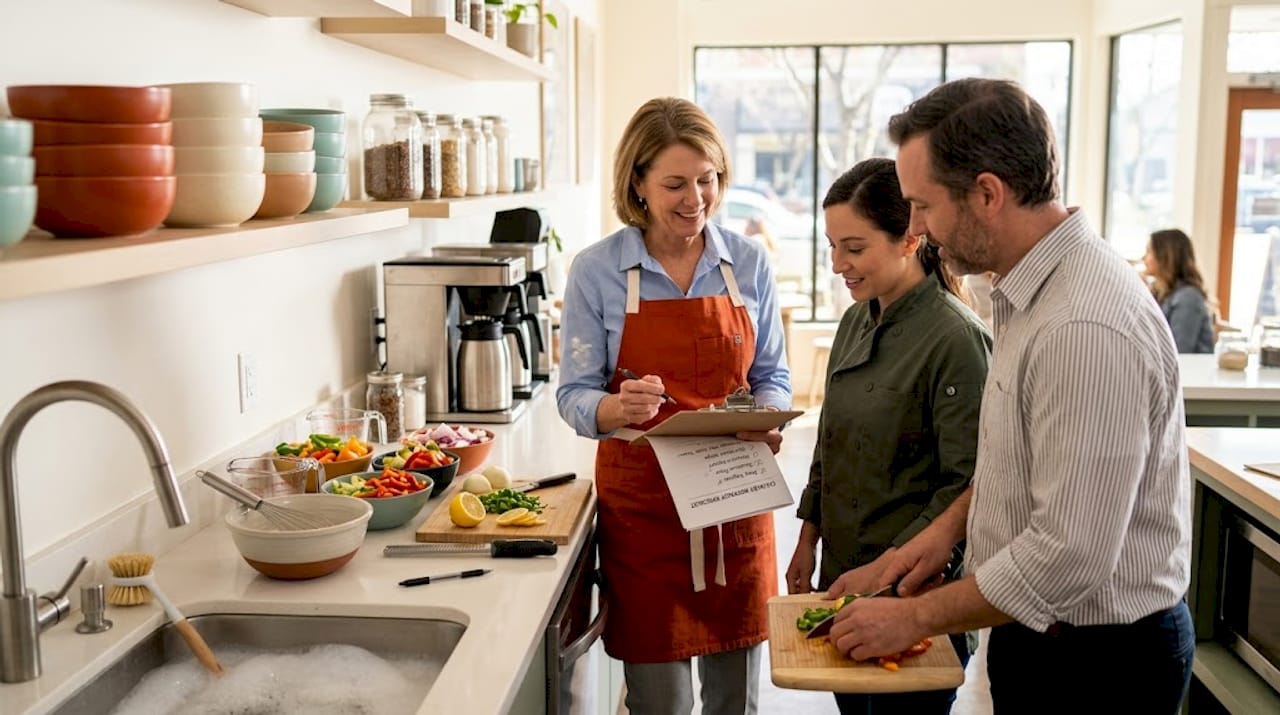
For more inspiration, explore team building ideas tailored to corporate groups, and check out how others have found ways to build team bonds through culinary experiences.
To fully appreciate experiential cooking’s impact, we explore the science behind learning through doing and its effect on team growth. There’s a reason this method works better than a keynote speaker or a personality assessment workshop. It’s backed by decades of learning theory.
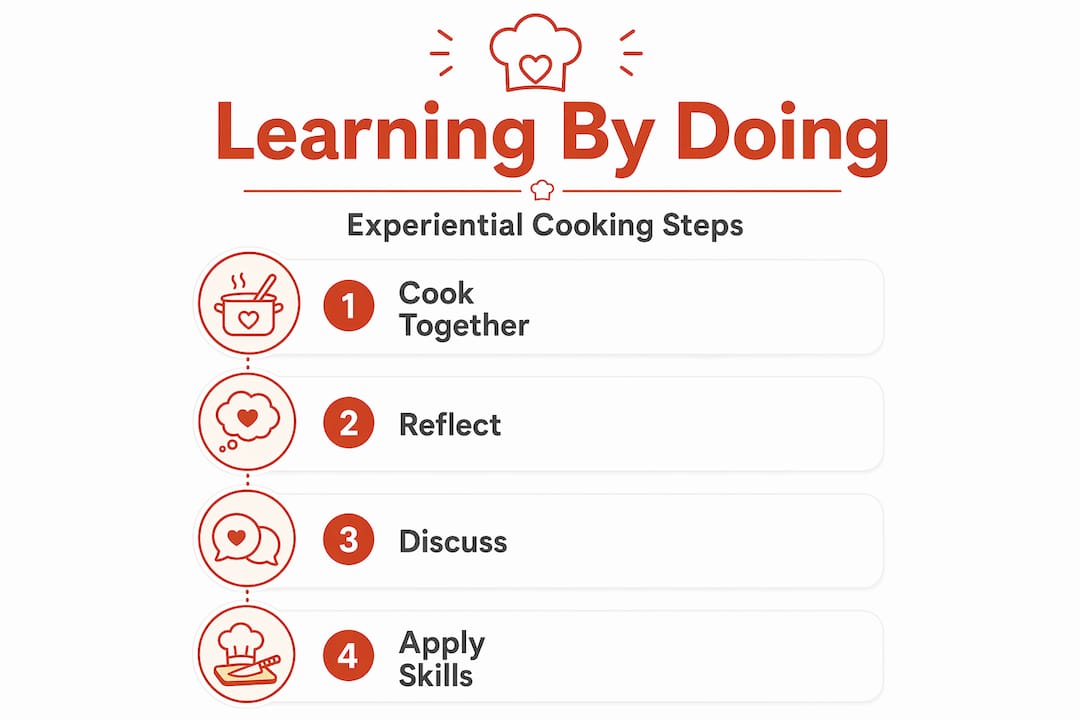
David Kolb’s Experiential Learning Theory, developed in the 1980s, argues that humans learn most effectively through a four-stage cycle: concrete experience, reflective observation, abstract conceptualization, and active experimentation. In plain terms, we learn best when we do something, think about it, understand why it worked or didn’t, and then try again. Experiential learning improves skill retention and real-world application precisely because it activates all four stages.
Experiential cooking hits every stage of that cycle naturally. The team cooks together (concrete experience), discusses what went wrong when the timing was off (reflective observation), figures out a better communication approach (abstract conceptualization), and adjusts mid-event (active experimentation). It’s not just a fun activity. It’s a learning loop.
Hands-on cooking programs improve not just skills but also mental resilience and confidence through experiential learning. That resilience translates directly to workplace behavior. Teams that have navigated a real-time cooking challenge together are better equipped to navigate a real-time project crisis together.
| Learning method | Skill retention rate | Real-world application | Team engagement |
|---|---|---|---|
| Lecture or presentation | Low (5 to 10%) | Limited | Passive |
| Discussion-based workshop | Moderate (20 to 30%) | Moderate | Mixed |
| Experiential activity (cooking) | High (70 to 80%) | Strong | Active |
Want to see how immersive cooking lessons connect to boost teamwork with cooking? The research makes a compelling case.
Here’s an opinion that might push back on conventional thinking: most corporate team-building programs fail not because they’re poorly designed, but because they don’t create any real stakes. A trust fall is low-risk. A personality quiz is private. A ropes course is optional in spirit, even if mandatory on the calendar. People go through the motions, check the box, and return to their desks unchanged.
Experiential cooking is different because the kitchen doesn’t pretend. When something isn’t working, everyone knows it. When someone steps up, the whole team benefits. The feedback loop is immediate and sensory: you can taste success, literally.
What we’ve seen time and again is that the teams who connect most deeply during culinary adventure experiences are not the ones who produced the best food. They’re the ones who recovered best when something went wrong. A collapsed soufflé handled with humor and fast regrouping teaches more about team culture than a year of off-sites.
There’s also an inclusivity angle that traditional team building consistently misses. Boosting team creativity through cooking works because food is universally human. Everyone has a relationship with food, regardless of background, seniority, or personality type. That shared humanity is the foundation that makes genuine connection possible.
For HR managers and team leaders, the practical implication is this: stop looking for the cleverest activity and start looking for the most honest one. Experiential cooking is honest in the best possible way. It reveals people, builds trust, and creates memories that stick long after the meal is over. That’s a result worth investing in.
Ready to bring experiential cooking to your team? Recipe for Success designs and delivers chef-led culinary team-building events built specifically for corporate groups. Whether you’re drawn to a high-energy culinary challenge team building cook-off or a collaborative guided session, every event is tailored to your team’s size, goals, and vibe.
Every experience we run puts teamwork at the center, not technique. Your team doesn’t need to know how to cook. They just need to show up ready to connect. From food-based team building events that spark real conversations to full-scale meal prep challenges, we handle everything so you can focus on your people. Explore our top culinary team building ideas and start planning an experience your team will actually talk about on Monday.
No prior cooking experience is needed. Facilitators ensure inclusivity for all skill levels and actively coach quieter participants so everyone contributes meaningfully throughout the event.
The three primary formats are guided cooking sessions that build skills through close facilitation, collaborative cook-offs with a competitive edge, and multi-course meal preparations that require full team coordination across an entire shared meal.
It places teams in real-time situations that require clear communication and shared responsibility. Team dynamics improve through the shared experience of creating something together, with benefits that extend well beyond the kitchen.
Experiential learning connects knowledge with action, dramatically improving skill retention and real-world application, which makes it far more effective than passive training formats for building genuine teamwork capabilities.